Home
Blog
Hybrid Cloud Automation for Multi-Site Scalability


by Techkooks
Published:
Hybrid cloud automation simplifies managing IT infrastructure across multiple locations. It uses tools like Terraform and Ansible to automate tasks such as resource provisioning, system configuration, and monitoring, ensuring consistency and efficiency. This approach addresses common challenges like inconsistent performance, configuration mismatches, and high costs by enabling centralized management, dynamic scaling, and real-time monitoring.
Key Points:
Automation Tools: Use Infrastructure as Code (IaC) tools like Terraform and orchestration platforms like Kubernetes to standardize deployments and workflows.
Scalability: Automate resource allocation to handle demand spikes efficiently while reducing costs.
Monitoring: Unified dashboards and automated alerts ensure performance, compliance, and cost control across all sites.
Edge Computing: Process data closer to users to reduce latency and improve application performance.
Cost Savings: Avoid idle resources and optimize spending with automated scaling and cost tracking.
Automation reduces manual effort, minimizes errors, and enhances reliability, enabling IT teams to focus on higher-value projects. For businesses operating in multi-site environments, hybrid cloud automation is a practical solution for improving efficiency and scalability.
Hybrid Cloud Infrastructure Automation with Ansible and Terraform (Part 3)
Core Components of Hybrid Cloud Automation
Expanding on the earlier discussion of scalability strategies, three key elements drive effective hybrid cloud automation across various sites. These components act as the technical foundation, ensuring smooth operations across multiple locations while reducing the need for manual effort.
Infrastructure as Code (IaC)
Infrastructure as Code (IaC) simplifies the management of resources in hybrid environments by using code to define and deploy infrastructure. Tools like Terraform and AWS CloudFormation make it possible to programmatically manage infrastructure, enabling seamless deployments across all locations.
Terraform is particularly noteworthy for its ability to work across multiple platforms, including AWS, Azure, Google Cloud, and on-premises data centers. With Terraform, you can write a single configuration file and deploy the same infrastructure to different environments without needing to rewrite code for each provider. This makes it easier to handle sudden spikes in demand with consistent and rapid deployments.
By treating infrastructure as code, you can version-control it just like application code. This approach allows teams to track changes, revert problematic updates, and maintain a detailed audit trail of modifications. For instance, if your East Coast data center faces an unexpected surge in traffic while the West Coast remains steady, predefined templates allow you to quickly allocate additional resources where they’re needed most. The growing adoption of such practices is reflected in the global cloud computing market, which is expected to surpass $1 trillion by 2028.
Orchestration and Workflow Automation
While IaC focuses on provisioning infrastructure, orchestration tools ensure that workloads run efficiently across hybrid environments. Kubernetes has become a go-to solution for container orchestration, offering a standardized approach across diverse infrastructures.
Kubernetes encapsulates applications in containers, bundling them with necessary dependencies to ensure consistent performance across different platforms. For example, a retail chain with stores nationwide could use Kubernetes to scale point-of-sale systems during Black Friday, distributing workloads across regional cloud zones and local servers in response to real-time demand.
In addition, tools like Jenkins streamline CI/CD pipelines, allowing simultaneous builds, tests, and deployments across multiple sites. This integration with hybrid cloud automation speeds up delivery while maintaining reliability and quality.
Orchestration platforms also handle critical tasks like service discovery, load balancing, and automatic failover. If one site encounters issues, the orchestration layer shifts workloads to healthier locations without requiring manual intervention. This capability is especially valuable for organizations with geographically distributed operations, where network conditions and resource availability can vary significantly.
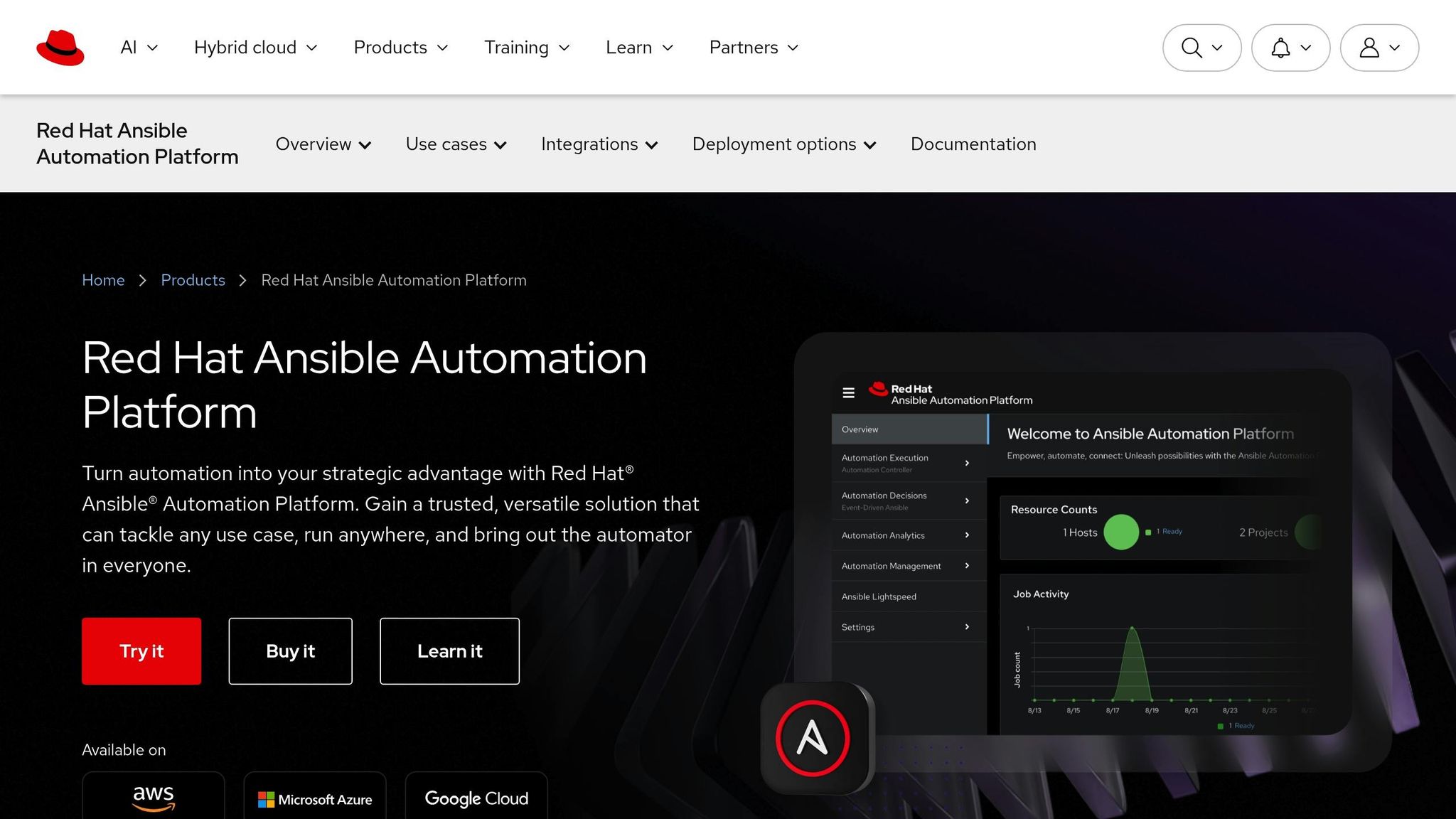
Red Hat’s automation mesh technology takes this a step further, enabling IT teams to deliver automation closer to endpoints in distributed environments. This enhances reliability and reduces the impact of network latency or connectivity disruptions, a crucial advantage for edge computing scenarios where connections may be inconsistent.
In tandem with orchestration, continuous monitoring plays a critical role in maintaining performance across all locations.
Monitoring and Management
Effective monitoring tools provide real-time insights into performance, security, and resource usage across all sites. Platforms like CloudBolt, IBM Multicloud Manager, and CloudHealth consolidate data from various cloud providers and on-premises systems into unified dashboards. These dashboards offer a centralized view of resource consumption, costs, and compliance metrics, simplifying management tasks.
Automated alerting systems are another essential component, notifying teams when performance metrics deviate from expected levels. For example, if API response times exceed 500 milliseconds in a specific region or CPU usage consistently surpasses 80%, the system sends alerts and can even trigger automated fixes. This ensures that critical operations, like transaction processing for a financial services company, remain uninterrupted, with failover systems automatically activated if primary infrastructure falters.
Automated drift detection further enhances security by restoring configurations that deviate from approved templates. This continuous validation helps enforce security policies, compliance standards, and performance benchmarks across all sites.
Advanced monitoring platforms also leverage predictive analytics to anticipate capacity constraints and adjust scaling policies dynamically. This creates a self-sustaining system that tracks, deploys, and optimizes infrastructure changes without requiring manual input, ensuring efficiency and reliability at every step.
Scaling Across Multiple Locations
Hybrid cloud automation truly shines when it comes to expanding operations across various regions. It's not just about adding more resources but doing so in a smart and efficient way that keeps everything running smoothly.
Dynamic Resource Allocation
Dynamic resource allocation is key to managing fluctuating demand across multiple locations. By automating this process, systems can monitor real-time demand and adjust resources based on predefined policies. For example, a company with data centers in New York, Chicago, and Los Angeles can set up automated triggers to add more compute power if CPU usage exceeds 70% in one location while scaling back underused resources elsewhere. With the help of machine learning predictions and Infrastructure as Code (IaC) policies, this approach ensures proactive scaling, reducing both idle resources and unnecessary costs. Tools like Terraform make it possible to maintain consistent and scalable allocation policies, so a demand spike in one facility is handled the same way across all locations. This kind of automation not only prevents over-provisioning but also helps businesses save money and stay agile during unexpected traffic surges. Plus, it creates a seamless transition for addressing latency issues at the network edge.
Edge Computing Integration
Edge computing takes things a step further by addressing latency directly. By processing data closer to end-users or remote locations, edge computing minimizes delays and boosts application performance. Instead of sending all requests to a central data center, edge nodes handle much of the processing locally, forwarding only essential data to central systems. In a hybrid cloud setup, orchestration tools can route latency-sensitive tasks to edge solutions or regional cloud zones, prioritizing proximity to users. For instance, a retail chain with stores nationwide might use edge nodes at regional distribution centers to process local sales transactions while central systems handle inventory and analytics. Automation mesh technology enhances this setup by enabling IT teams to deploy and manage automation closer to the devices that need it. This results in better reliability and resilience against network latency or disruptions. Platforms like Red Hat Ansible play a crucial role here, ensuring consistent policies and security across all edge locations while keeping latency low for critical operations.
Example: Seasonal Demand Scaling
E-commerce platforms often face the challenge of handling massive traffic surges during busy shopping seasons while keeping costs down during quieter times. For example, a media streaming company demonstrated automated seasonal scaling by adding resources during peak viewing times - like live sports events or new show releases - and scaling back during off-peak hours. In e-commerce, holiday shopping spikes, such as Black Friday, can see traffic increase by 300% to 400% compared to normal periods. Automation kicks in weeks ahead, using historical data to prepare for these surges. Kubernetes helps distribute containerized workloads across clouds and on-premises systems, balancing regional demand efficiently. By combining reserved instances for baseline capacity with spot instances for overflow traffic, companies can significantly cut costs compared to relying solely on static, on-demand pricing. Real-time dashboards provide visibility into scaling activities, allowing teams to tweak automation policies if demand deviates from forecasts. This automated process eliminates the need for last-minute capacity planning, ensuring systems can handle traffic spikes quickly and maintain consistent performance, no matter the time or location. These strategies highlight how hybrid cloud automation ensures smooth operations across all locations, even during the most demanding times.
Reducing Overhead with Automation
Managing multi-site infrastructure can be a drain on resources and often leads to costly mistakes. Automation steps in to ease these burdens by handling repetitive tasks, streamlining processes, and allowing IT teams to shift their focus toward strategic projects instead of routine upkeep. In hybrid cloud setups spread across various locations, automation often determines whether an operation struggles to keep pace or runs efficiently. A key starting point for reducing the overhead of multi-site management is standardizing workflows.
Standardizing Workflows
One of the toughest hurdles in multi-site deployments is ensuring consistency. Without standardized practices, each location might end up with slightly different configurations, security protocols, or deployment methods. These inconsistencies can make it harder for IT teams to maintain control, potentially leading to security gaps or performance issues.
Tools like Infrastructure as Code (IaC) - such as Terraform and Ansible - help address this challenge. They allow you to define infrastructure once and roll it out uniformly across all sites, whether you're working with AWS, Azure, Google Cloud, or your own data centers. This approach ensures consistent application of configuration standards and best practices across the board.
Orchestration tools like Kubernetes and Jenkins take things a step further by executing identical workflows at every location, removing the need for manual configuration. Whether deploying in one facility or another, the same steps are followed, eliminating inconsistencies that arise from human intervention.
Standardized workflows also make automation easier and break down operational silos. When everyone follows the same procedures, collaboration becomes smoother, troubleshooting is faster, and onboarding new team members is less complicated. Instead of juggling dozens of unique configurations, you adopt a uniform approach that scales seamlessly across your entire infrastructure.
Reducing Human Error
Building on standardized workflows, automation also minimizes the risk of human error. Multi-site hybrid cloud environments are particularly vulnerable to mistakes due to the complexity of manual processes. Automation mitigates these risks by taking over routine tasks that typically require manual input.
Common configuration errors - like inconsistent security settings, resource mismanagement, or network mismatches - can lead to service disruptions or even security breaches. Automation helps prevent these issues by ensuring that each task is executed consistently.
Manual processes also often fall short during peak demand periods, leading to service degradation or outages. In multi-site environments, where updates need to be coordinated across locations, automation ensures changes are synchronized and executed correctly. This reduces the likelihood of scaling issues or downtime caused by human oversight.
Complex deployment procedures are another area where automation shines. By encoding every necessary step into automated workflows, organizations can avoid skipped or incomplete actions. This reduces the risk of accidental data loss, misconfigured security settings, or service interruptions - all of which can arise from manual errors.
Onboarding and Knowledge Transfer
Onboarding new IT staff in a multi-site hybrid cloud environment can be a lengthy process. New team members often have to familiarize themselves with location-specific practices, custom configurations, and undocumented procedures. Automation significantly shortens this learning curve by standardizing processes across the entire IT landscape.
Instead of learning separate workflows for each site, new hires can rely on standardized IaC templates and automated processes to get up to speed quickly. This consistency not only accelerates onboarding but also reinforces best practices that minimize errors across all locations.
Automation also safeguards institutional knowledge. By embedding critical processes in code and workflows, organizations can ensure continuity even when experienced team members leave. This approach protects against knowledge loss and keeps essential operations running smoothly.
Centralized management platforms further simplify multi-site operations by providing a unified interface for monitoring and managing resources across locations. This reduces the need for site-specific training and enables IT staff to apply their skills effectively, no matter where resources are located. For example, an engineer in one city can manage resources in another just as easily as if they were local.
Automation mesh technology adds another layer of efficiency by bringing automation closer to the endpoints. Instead of centralizing all execution, this approach allows automation to happen locally at each site or edge location. This improves reliability, reduces network latency, and ensures that automation practices remain consistent globally while accommodating unique requirements at individual sites, such as regional compliance or performance needs.
As edge environments expand and demands grow, automation mesh enables IT teams to scale operations without adding more staff or increasing complexity. By reducing the overhead of managing multi-site deployments, automation empowers teams to handle more locations with ease.
For tailored automation strategies that fit your organization's specific needs, consider reaching out to IT Support Services - Tech Kooks (https://techkooks.com) for expert advice and assistance.
Implementation Best Practices
Deploying hybrid cloud automation across multiple sites can be challenging. To ensure smooth operations, it's crucial to adopt a structured approach that balances consistency, control, and the flexibility needed to manage diverse environments. Below, we’ll explore key practices to streamline deployment and management.
Using Unified Tools and Platforms
Managing hybrid cloud environments becomes increasingly complex when each site relies on different tools and platforms. A unified approach simplifies operations, providing visibility and control across all locations.
Multi-cloud platforms like CloudBolt and IBM Multicloud Manager offer centralized dashboards to monitor performance, security, and usage across environments. These tools help teams maintain oversight without juggling multiple systems.
When choosing tools, prioritize Infrastructure as Code (IaC) platforms such as Terraform and Ansible. These enable you to define infrastructure configurations once and deploy them consistently, regardless of the cloud provider. For workflow orchestration, tools like Kubernetes and Jenkins automate deployments, reducing manual effort and minimizing errors.
Your hosting strategy also matters. Cloud-hosted platforms work well for distributed resources, while on-premises solutions may be better for centralized infrastructure. Unified platforms also excel in cost tracking. By integrating tools like AWS Cost Explorer, Azure Cost Management, and Google Cloud Billing, you can consolidate spending data and pinpoint areas for savings. Similarly, centralized monitoring tools such as Datadog, Splunk, and Prometheus provide comprehensive logging and alerting, ensuring seamless oversight of your hybrid cloud setup.
To maximize efficiency, ensure your tools support API-driven architectures. This facilitates seamless data sharing and workflow integration, laying the groundwork for the next step - standardized templates.
Creating Standardized Configuration Templates
Standardized configuration templates are the backbone of consistent deployments across multiple sites. They eliminate guesswork and ensure every deployment aligns with proven patterns.
Using cloud-agnostic tools like Terraform, you can create repeatable, version-controlled templates. These templates should define workload placement strategies based on factors like performance, security, cost, and compliance. For instance, high-performance workloads may be best suited for optimized public cloud instances like AWS EC2 or Google Cloud Compute Engine, while sensitive or compliance-driven applications might require private clouds or on-premises infrastructure. Latency-sensitive applications could benefit from edge computing or regional cloud zones closer to end users.
Containerization with Kubernetes ensures applications remain portable and consistent. Breaking applications into microservices allows for modular deployment while maintaining standardization. Including cost allocation tags in templates from the start ensures accurate tracking of resource usage by project, department, or application, simplifying optimization efforts. Additionally, documenting these templates creates a single source of truth, streamlining onboarding for new team members and ensuring uniformity.
Once templates are in place, the focus shifts to real-time monitoring to maintain operational excellence.
Real-Time Monitoring and Optimization
Real-time monitoring is crucial for identifying and resolving issues before they disrupt operations. It provides continuous visibility across all sites, allowing teams to act proactively.
Unified dashboards in multi-cloud management platforms consolidate performance, security, and usage metrics into one view, making it easier to detect anomalies. Machine learning-powered provisioning can dynamically scale resources based on real-time demands, historical usage patterns, and forecasted workloads. This ensures capacity is available when needed while avoiding unnecessary costs from idle resources.
Budgeting tools and alerts can flag spending anomalies, which may signal performance issues. For consistent data management, distributed data stores like Amazon S3 Cross-Region Replication or Google Cloud Storage Transfer Service help maintain uniformity across regions. Automated backups and centralized data lakes further secure data integrity and simplify analytics.
Automated incident response systems can detect issues like unexpected usage spikes or performance drops and trigger immediate corrective actions. Configuring zone preferences ensures smooth failover between regions, maintaining uninterrupted performance. Predictive monitoring, which identifies potential issues based on trends, gives teams ample time to address problems before they escalate.
For organizations seeking expert guidance, Tech Kooks (https://techkooks.com) provides support for hybrid cloud automation. Their services include proactive monitoring, seamless integrations, and tailored strategies designed for multi-site operations.
Business Outcomes of Hybrid Cloud Automation
Expanding on the technical advantages we’ve discussed, hybrid cloud automation also delivers notable business benefits. By streamlining operations across multiple locations, it boosts performance, reduces costs, and enhances resilience. These operational gains naturally translate into strategic advantages for businesses.
Improved Agility and Scalability
Hybrid cloud automation allows organizations to respond faster to market changes by enabling the provisioning of entire environments in just minutes. This speed empowers businesses to launch new services quickly, seize market opportunities, and iterate on products efficiently.
Red Hat reported that organizations using their automation platform achieved a 668% return on investment over three years, with faster time to market being a standout benefit.
This rapid pace is crucial in competitive industries, where being first to introduce new features or services often determines market leadership.
Agility isn’t limited to a single location - it spans all operational sites. Tools like Terraform and Ansible enable businesses to define infrastructure once and deploy it consistently across on-premises and cloud environments. Automated scaling further eliminates manual inefficiencies, as systems dynamically adjust computing power, storage, and bandwidth based on real-time demand. This is especially valuable for businesses operating across different time zones or serving markets with varying peak periods.
Additionally, automation accelerates deployment frequencies. Development teams can release updates more often and with confidence, thanks to automated testing pipelines that validate changes continuously. Instead of the weeks-long manual deployment processes of the past, automation ensures consistent and simultaneous rollouts across all locations.
Cost Optimization and Resource Efficiency
Alongside agility, cost savings are a major advantage of hybrid cloud automation. By optimizing resource use and eliminating waste, organizations can achieve significant financial benefits. For instance, right-sizing ensures that resources are fully utilized, while reserved and spot instances offer cost savings for predictable and non-critical workloads.
Automation also cuts costs by provisioning and deprovisioning resources based on demand. During periods of low activity, systems automatically scale down, preventing businesses from paying for idle capacity. Cost allocation tagging - by project, department, or application - provides clear insights into spending patterns, helping identify areas for optimization that might otherwise be overlooked.
Multi-cloud management platforms add another layer of efficiency by consolidating resource usage and cost tracking across environments. Businesses can compare costs across providers and shift workloads to the most cost-effective option based on current pricing and performance.
Automation doesn’t just save money - it saves time, too. By eliminating repetitive tasks, IT teams can focus on strategic projects rather than routine maintenance. This efficiency enables businesses to manage larger, more complex infrastructures without needing to increase staff.
Preventing downtime is another key financial benefit. Automated incident response systems detect issues - like usage spikes or performance drops - and trigger corrective actions immediately. Resolving problems in minutes, rather than hours, significantly reduces the cost and impact of disruptions.
Infrastructure as Code also helps prevent configuration drift by maintaining a single source of truth. This reduces the time and expense required to identify and fix inconsistencies across multiple locations.
Business Continuity Improvements
Automation transforms how organizations handle disaster recovery and business continuity. Instead of relying on error-prone manual processes during critical situations, automated systems execute recovery procedures quickly and consistently.
Automated backups and cross-region replication ensure rapid data recovery in the event of failures. Disaster recovery procedures can be defined as code, making them testable, versioned, and consistently executed. If a primary data center goes offline, automated failover mechanisms redirect traffic to secondary sites without human intervention, minimizing downtime.
Orchestration tools like Kubernetes and Jenkins simplify workflows across environments, reducing manual involvement and the risks associated with recovery efforts. This leads to significantly faster recovery times, as systems can self-heal or execute predefined recovery steps without waiting for human intervention.
Automation also strengthens security, which directly influences business continuity. Automated compliance checks and policy enforcement reduce the risk of security misconfigurations that could lead to breaches or service disruptions. In multi-site operations, maintaining consistent security standards becomes manageable with automated configuration management.
Reliability improves as well. When operational standards are embedded in automation code, they can be enforced and audited across all locations. Teams can track changes, roll back problematic updates, and ensure compliance with organizational policies without relying on manual checks.
Tech Kooks (https://techkooks.com) supports organizations in implementing these continuity enhancements. Their proactive monitoring, automated disaster recovery planning, and scalable strategies are designed to keep multi-site operations running smoothly, even during major disruptions.
Finally, automation helps preserve institutional knowledge. By defining infrastructure and workflows as code, businesses shift operational know-how from informal, team-member-specific knowledge to documented procedures. This ensures continuity, even during employee turnover, and enables new team members to quickly understand systems by reviewing the code. These improvements reinforce the benefits of standardized automation, ensuring consistent performance across all locations.
Conclusion
Hybrid cloud automation has become a key strategy for businesses managing operations across multiple locations. By streamlining complex, multi-site infrastructures, automation enables systems to adapt dynamically to business needs, improving efficiency and reducing operational headaches.
Using tools like Infrastructure as Code, orchestration platforms, and unified monitoring, businesses can standardize configurations, minimize manual errors, and scale operations effectively - all while keeping costs under control. These technical improvements directly translate into real-world advantages: faster service launches, smarter resource management to cut costs, and stronger resilience during disruptions. Together, these benefits enhance a company's ability to compete, remain profitable, and stay adaptable.
However, successful hybrid cloud automation goes beyond just picking the right tools. It requires a thorough understanding of your infrastructure, strong governance, and ongoing fine-tuning. This is where partnering with experts like IT Support Services - Tech Kooks (https://techkooks.com) can make a difference. They begin with a detailed audit to uncover inefficiencies and create tailored strategies that align with your workflows, scalability needs, and business goals. Their services - ranging from cloud integration and automation to proactive monitoring and continuous optimization - help build scalable, efficient architectures without unnecessary complexity.
Getting started doesn’t mean overhauling everything at once. Focusing on small, impactful projects can deliver quick wins, building momentum for larger automation efforts over time. Gradually, automation becomes a natural part of your operations, driving consistent improvements.
Whether you're managing a handful of locations or a sprawling network, the fundamentals remain the same: standardize processes, automate repetitive tasks, monitor constantly, and refine continuously. Businesses that embrace these principles are better equipped to adapt to market shifts, scale smoothly, and operate with greater efficiency. Hybrid cloud automation isn’t just a technical upgrade - it’s a strategic edge that fuels sustainable growth.
FAQs
How can hybrid cloud automation help lower costs for multi-site operations?
Hybrid cloud automation offers a powerful way to cut costs in multi-site operations by simplifying how resources are managed and reducing the need for hands-on involvement. By automating tasks, workloads are distributed efficiently across various locations, helping to avoid waste and prevent overprovisioning.
It also allows for proactive monitoring and faster problem-solving, which means less downtime and fewer expenses tied to on-site IT support. With scalable automation tools, businesses can adjust to shifting demands without overspending on infrastructure, ensuring operations stay efficient and budget-friendly over time.
How does Infrastructure as Code (IaC) help maintain consistency across hybrid cloud environments?
Infrastructure as Code (IaC) is a game-changer for ensuring consistency in hybrid cloud environments. By using code to define and manage infrastructure configurations, you can build and configure environments - whether on-premises or in the cloud - in a uniform way. This reduces the likelihood of manual mistakes and eliminates mismatches between setups.
Another major advantage of IaC is automation. It simplifies updates and deployments, allowing businesses to scale effortlessly across different locations while maintaining synchronized configurations. The result? More reliable systems and smoother operations, all while saving time and resources for companies aiming to grow without a hitch.
How does edge computing improve application performance in a hybrid cloud environment?
Edge computing boosts application performance in hybrid cloud environments by handling data closer to its source. This minimizes latency and speeds up response times, which is especially useful for businesses operating across multiple locations. The result? Faster data access and smoother application functionality.
On top of that, edge computing eases the strain on central cloud resources by managing certain tasks locally. This approach not only optimizes bandwidth usage but also helps cut operational costs. Incorporating edge computing into a hybrid cloud strategy enables organizations to scale more effectively and enhance the reliability of their applications.
Related Blog Posts
Tools:
You might also like
BLOG POST
How Remote IT Support Scales with Business Growth
Cloud-based remote IT support uses automation, centralized management, and flexible pricing to scale performance, security, and costs as your business grows.
BLOG POST
Top Remote Troubleshooting Software 2025
Compare leading remote troubleshooting tools in 2025—security, diagnostics, ease of use, pricing, and best use cases to find the right IT support solution.
BLOG POST
How To Optimize Hybrid Cloud for Multi-Site Businesses
Guide to optimizing hybrid cloud for multi-site businesses: keep sensitive systems local, sync data efficiently, automate deployments, enforce security.